
Built at Squibb
What we’ve built.
Not decks. Working systems.
Every recommendation we make to a client comes from patterns we’ve tested on ourselves first. The systems below are internal builds: real architecture, real code, real constraints. The design patterns from these builds transfer directly to client engagements across any domain.
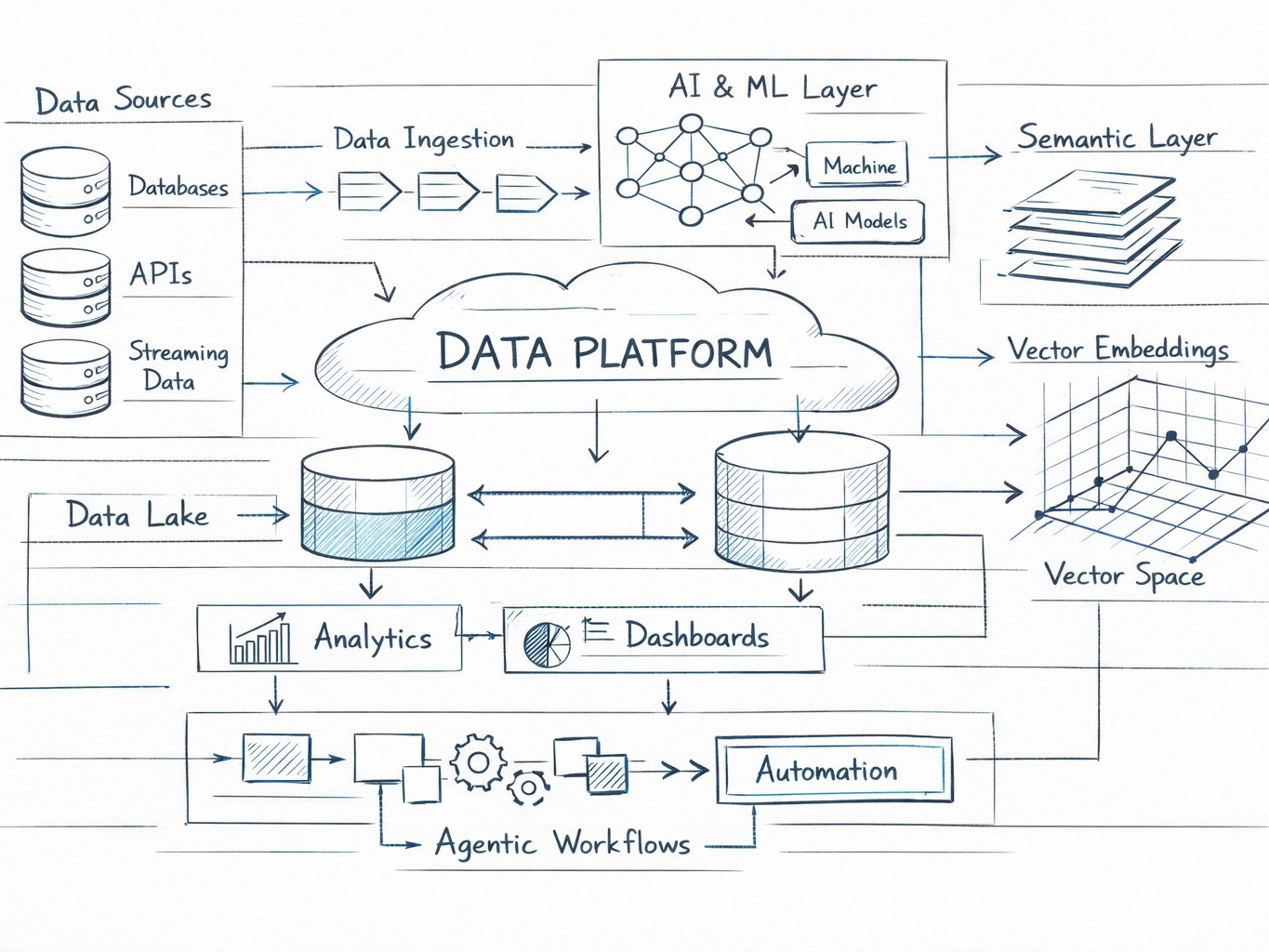
A working view of the data platform architecture we think in. From ingestion through analytics to agentic workflows.
System 01
Intelligent Workforce Platform
What it is
A people management system with embedded AI capabilities, built on a tiered LLM routing architecture.
Architecture highlights
Tiered LLM routing that selects the appropriate model based on task complexity and cost profile. Tenant-scoped agent configuration with isolated data boundaries. Cost-aware AI deployment that achieves enterprise-grade capabilities without open-ended API spend.
What it proves
Production AI is achievable without production-scale budgets. The right routing architecture makes intelligent features commercially viable across multiple tenants.
Transferable patterns
Tiered intelligence routing. Cost-aware inference. Tenant-scoped AI isolation.
System 02
Agentic Systems for Regulated Contexts
What it is
A healthcare-oriented platform with patient-facing AI capabilities, built for a domain where accuracy and auditability are non-negotiable.
Architecture highlights
Agentic patterns for autonomous task handling within defined boundaries. Tenant-scoped configuration allowing per-context customization. Traceability and audit trails designed into the agent layer, not added afterwards.
What it proves
Agentic AI works in environments where getting it wrong has real consequences. Reliability and traceability come from architecture decisions, not from bolting compliance onto a prototype.
Transferable patterns
Agentic workflow design. Regulated-context AI deployment. Audit-ready agent architecture.
Framework
The Pattern Library
What it is
The architectural decisions from our internal builds, extracted and documented as reusable design patterns for client engagements.
Architecture highlights
Tiered intelligence routing for cost-effective LLM deployment. Tenant-scoped agent configuration for multi-client isolation. Cost optimization frameworks that make AI commercially sustainable. Event-driven pipelines for real-time data flow.
What it proves
The value of internal builds is not the builds themselves. It is the transferable patterns they produce. Every client engagement benefits from architecture that has already been stress-tested.
Transferable patterns
All of the above, applied to your domain.
About
Squibb Consulting builds enterprise data architecture, applied AI systems, and learning programs. Two integrated practices, practitioner-led since 2017. Working with clients across the US and India.
Featured Posts


Contact info
Squibb Consulting LLP
- #1028, DNK Square, Viman Nagar
- Pune, Maharashtra 411014, India
- (+91) 95117 88458
- contact@squibb.in